
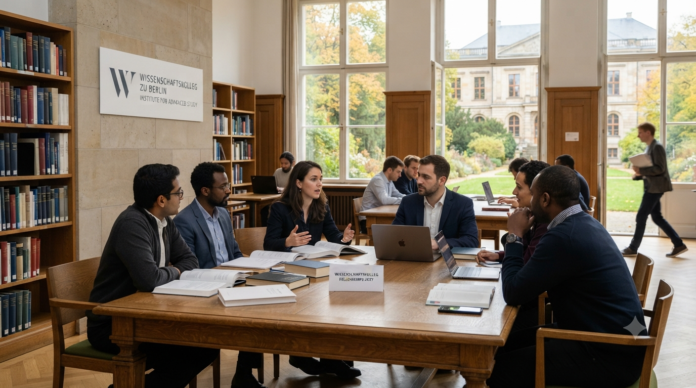
Wissenschaftskolleg zu Berlin Opens Application window for the Fellowship program for the 2027 intake in Germany,This Fellowship Program Are Designed for International Researcher but point to note This is not a free scholarship to begin a PhD program or pursue a university degree. Researchers who will already have a PhD by the time their Berlin residency starts are eligible for this early-career award.
What Are the Important Details of the Wissenschaftskolleg Fellowships 2027?
| Information | Details |
|---|---|
| Fellowship Name | Wissenschaftskolleg zu Berlin Fellowships 2027 |
| Host Institution | Wissenschaftskolleg zu Berlin – Institute for Advanced Study |
| Program | College for Life Sciences |
| Study/Research Location | Berlin, Germany |
| Fellowship Duration | 3–5 months |
| Fellowship Period | September 2027 – July 2028 |
| Eligible Fields | Life sciences, natural sciences, medicine and psychology |
| Eligible Applicants | International early-career researchers |
| Nationality Requirement | No nationality restriction |
| Age Restriction | No age restriction |
| Funding | Full stipend based on previous salary |
| Accommodation | Studio accommodation on campus |
| Application Opens | July 8, 2026 |
| Application Deadline | November 1, 2026, 23:59 CET |
| Degree Requirement | Doctorate obtained before fellowship begins |
| Publication Requirement | At least one lead-author peer-reviewed journal publication |
| Official Application | Wissenschaftskolleg application platform |
What Benefits Does the Wissenschaftskolleg zu Berlin Fellowship Provide?
- On-campus studio housing in addition to a full stipend determined by their prior pay.
- Travel expenses,
- Relocation support,
- Daily lunches,
- IT and library services,
- Aid with German registration and immigration paperwork.
- There isn’t a single monthly sum that Wissenschaftskolleg promotes. The successful applicant’s prior wage determines the ultimate compensation.
- Families and partners are welcome; however, due to the institute’s limited housing stock, appropriate family accommodations cannot be guaranteed.
- Before making assumptions regarding space, prices, or educational arrangements, applicants who intend to move with kids or a spouse should get in touch with the program.
READ: ICANN88 Fellowship Program 2027 in Portugal (Fully Funded) | Apply Now
Who Can Apply for the Wissenschaftskolleg Fellowships 2027?
- Candidates may be from the natural sciences, psychology, medicine, or life sciences.
- Postdoctoral researchers, physicians, junior group leaders, instructors, assistant or associate professors, and early-career principle investigators are among the career stages that qualify.
- There are no restrictions on age, nationality, or specific subjects. However, candidates need to:
- Possess a PhD, MD, or similar doctorate by the time the fellowship begins.
- Possess a minimum of one peer-reviewed journal publication as a main author.
- Be just starting out in their research career.
- Work outside of a Berlin-based organization
- A minimum of two years of postdoctoral experience is typically required of successful candidates, but this is not a mandatory requirement but rather a sign of competitiveness.
- It is recommended that researchers who have been primary investigators for more than five years apply for a standard Wissenschaftskolleg fellowship instead.
- Therefore, current PhD students are only eligible to apply after they have officially earned their PhD before starting the residency.
What Documents Are Required for the Application?
- Completed application form
- Updated Curriculum Vitae (CV) or Résumé
- A 1,000-word project idea,
- A 500-word motivation letter,
- List of up to five significant publications
- Other Relevant Supporting Documents
When Is the Wissenschaftskolleg Fellowships 2027 Application Deadline?
The last date to apply for the Wissenschaftskolleg zu Berlin Fellowships 2027 in Germany for international students is 1st November 2026.
Get More Opportunities
Scholarships For International Students
How Can You Apply for the Wissenschaftskolleg zu Berlin Fellowships 2027?
- Review the official eligibility requirements.
- Prepare a project proposal of up to 1,000 words.
- Prepare a motivation letter of up to 500 words.
- Update their CV.
- Prepare their publication list.
- Complete the online application.
- Submit the application before November 1, 2026, at 23:59 CET.

Frequently Asked Questions (FAQs)
What is the Wissenschaftskolleg zu Berlin Fellowship 2027?
It is an early-career research fellowship offered through the Wissenschaftskolleg zu Berlin’s College for Life Sciences for researchers in the life sciences, natural sciences, medicine, and psychology.
Where will the Wissenschaftskolleg Fellowship take place?
The fellowship takes place at the Wissenschaftskolleg zu Berlin in Berlin, Germany.
Who is eligible for the Wissenschaftskolleg Fellowship?
Early-career researchers in the life sciences, natural sciences, medicine, and psychology who meet the doctorate and publication requirements can apply.
Can international students apply for this fellowship?
Yes. There is no nationality restriction, and international researchers are encouraged to apply if they meet the eligibility requirements.
Is the Wissenschaftskolleg Fellowship fully funded?
The fellowship provides a full stipend based on the fellow’s previous salary and includes studio accommodation on campus and other services.
How long does the Wissenschaftskolleg Fellowship last?
The College for Life Sciences fellowship lasts between three and five months.
When will the 2027 fellowship take place?
The residency will take place during the 2027–2028 academic year, between September 2027 and July 2028.
What is the application deadline for the fellowship?
The deadline is November 1, 2026, at 23:59 CET.
Do I need to have a PhD before applying?
You must have obtained your doctorate before the fellowship begins.
Can current PhD students apply?
Current PhD students can only be eligible if they will have officially obtained their doctorate before the fellowship starts.
How many years of postdoctoral experience are required?
Successful candidates usually have two or more years of postdoctoral experience, although this is not stated as an absolute mandatory requirement.
Is there an age limit for applicants?
No. The official call does not impose an age restriction.
Is there a nationality restriction?
No. Applicants of all nationalities can apply.
Can researchers working in Berlin apply?
Researchers working at institutions in Berlin cannot be considered for this particular early-career call.
Does the fellowship provide accommodation?
Yes. Studio accommodation on campus is included as one of the fellowship benefits.
Does the fellowship provide a fixed monthly stipend?
No. The stipend is based on the fellow’s previous salary rather than one fixed amount for all fellows.
Does the fellowship provide laboratory facilities?
No. The College for Life Sciences does not provide laboratory space.
Can I conduct wet-lab experiments during the fellowship?
The program is designed to give researchers time away from laboratory routines, so projects that require new wet-lab experiments in Berlin are not suitable.
What documents are required?
Applicants need a project proposal, motivation letter, CV, and publication list.
How long should the project proposal be?
The project proposal should be no more than 1,000 words.
How long should the motivation letter be?
The motivation letter should be no more than 500 words.
How many publications are required?
Applicants must have at least one lead-author publication in a peer-reviewed journal.
Do I need a Berlin-based supervisor?
No. The fellowship does not require applicants to have a Berlin host supervisor.
Do I have to choose a predefined research topic?
No. Applicants have freedom to choose the project they wish to pursue during their residency.
Where can I apply for the fellowship?
Applications are submitted online through the official Wissenschaftskolleg application platform.
What makes a strong fellowship application?
A strong application should present a clear and important research idea, demonstrate academic potential, and explain why an interdisciplinary environment and time away from normal research routines would benefit the project.